

Business Model Generation
A Handbook for Visionaries, Game Changers, and Challengers – Alexander Osterwalder and Yves Pigneur. We came across this while building the Skills section. It kept showing up.
We came across this book while putting together the Skills section on DecodedCareers. It kept appearing in reading lists, business school syllabuses, and the bookshelves of people who think seriously about how organisations work. It was published in 2010. It is still being bought, underlined, and argued about.
That is unusual. Most business books have a shelf life of about eighteen months. Something in this one has held.
Curation angle
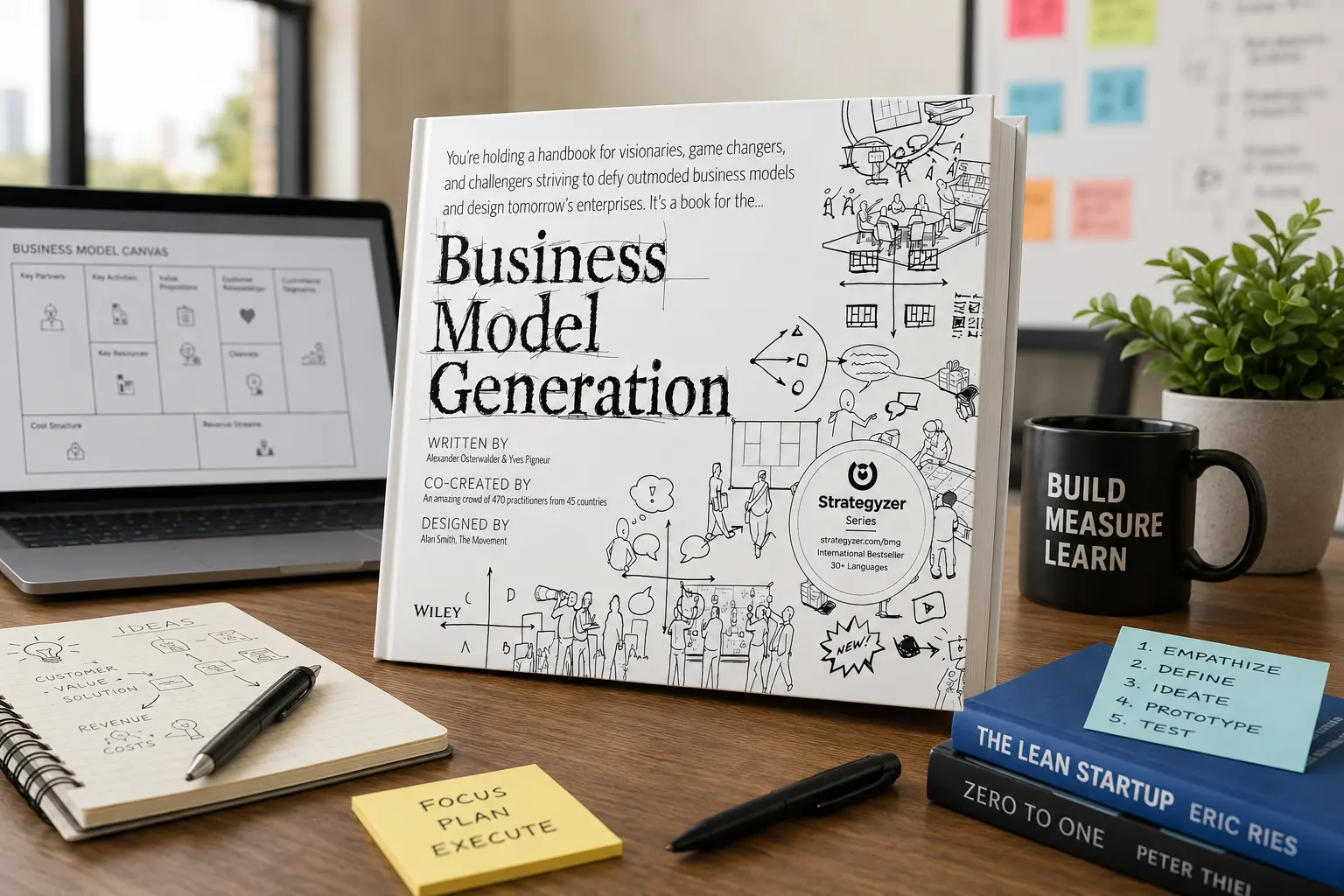
Image is AI generated for illustration purposes only.
What This Book Actually Is
Business Model Generation introduces the Business Model Canvas – a one-page visual tool that maps out how any organisation creates, delivers, and captures value. The Canvas has nine building blocks:
- Customer Segments – who you are creating value for
- Value Propositions – what specific problem you solve for them
- Channels – how you reach your customers
- Customer Relationships – what type of relationship each segment expects
- Revenue Streams – how the business makes money
- Key Resources – what strategic assets are required
- Key Activities – what the company must do to execute
- Key Partnerships – which alliances and suppliers help the model work
- Cost Structure – what the major costs of running the model are
“A business model describes the rationale of how an organisation creates, delivers, and captures value.”
That sentence is from the book. It sounds obvious until you sit with it and try to apply it to your own employer – and find that you genuinely do not know where their revenue comes from, what their key costs are, or why customers choose them over competitors. Most people who work at a company for years cannot fill in all nine blocks for that company without guessing.
The Canvas is freely available online – Osterwalder put it in the public domain. But the book explains the thinking behind each block in a way that makes you use the tool properly, not just fill in a template mechanically. That is the difference between having a hammer and knowing where to hit.
One Example to Make It Concrete
Take a mid-level finance professional at a Bengaluru IT services company. She manages client invoicing, accounts receivable, and monthly cost reporting. She knows her work well.
Apply the Canvas to her employer. The customer segment is global enterprises that want IT work done at lower cost than onshore. The value proposition is skilled engineers at a fraction of US or European rates. Revenue comes from time-and-material contracts. Key resources are the engineers. Key activities are talent acquisition, project delivery, and client relationship management. Her work – invoicing and cost reporting – sits directly inside the Cost Structure and Revenue Streams blocks.
That shift in perspective is not small. When she understands her work as part of a business model rather than as a list of tasks, she starts asking different questions in budget meetings. She spots inefficiencies that others in finance miss. She can articulate her department’s value in terms the leadership cares about. The Canvas did not teach her finance – she already knew that. It taught her how to see the machine her work runs inside.
Business Model Generation
Alexander Osterwalder and Yves Pigneur · Kindle Rs 353 on Amazon India
View on Amazon IndiaAffiliate link. We earn a small commission if you purchase, at no extra cost to you.
What Amazon India Readers Say
This book has 4,230 ratings on Amazon India with 72% giving it five stars. Here are five reviews from verified Indian purchasers, reproduced as written.
Who Will Get the Most From This
Freshers entering the workforce
Most freshers join companies without understanding how the company makes money or where their role fits in that logic. Reading this book in the first six months gives you a mental model that colleagues typically develop only after five years of trial and error.
Mid-career professionals who feel stuck
If you have been doing good work but not getting the growth you expect, the Canvas can help you map your own value proposition inside your organisation. What do you uniquely do, for whom, and how does it connect to what the business actually cares about? That clarity changes the conversations you have about your career.
Founders and entrepreneurs at any stage
The book was co-created by 470 strategy practitioners from 45 countries. It is dense with real company examples – Skype, Wii, Nespresso, Apple iPod. If you are building something, the Canvas is a faster way to stress-test your business logic than three months of strategy meetings.
Anyone considering a side business or career switch
The Canvas works equally well on your personal career as it does on a company. Some readers use it to map themselves as a product – what they offer, to whom, through which channels, and at what cost. That sounds abstract until you try it and realise how much clarity it forces.
What the Book Does Well
The visual design is genuinely good. This is a 288-page full-colour handbook, not a textbook. Each concept is illustrated with diagrams, real company case studies, and one-page visual summaries. The kind of book you return to as a reference rather than having to re-read cover to cover.
The section on business model patterns is the strongest part. It breaks down recurring structures – the long tail model, multi-sided platforms, the freemium model, open business models – and shows how the same nine-block logic plays out differently in each. Reading this alongside Indian companies you know is a useful exercise on its own.
What It Does Not Do
It does not tell you how to execute. The Canvas is a design tool, not an implementation guide. Once you have mapped your business model, the book does not tell you what to do next. That is not a flaw – it is a deliberate scope decision – but worth knowing before you buy.
Two books that pair well with this one if execution is what you need:
Is the Kindle Edition Worth Rs 353
Yes. At the time of writing it is 73 percent off the original price. The Kindle edition preserves the visual design well enough to be useful – though the full-colour physical edition is nicer to read if you prefer paper. The Kindle price is the better value if you want to start today.
The physical paperback is Rs 1,775 – still reasonable for a book of this production quality, but the Kindle price is the practical entry point.
Business Model Generation
Kindle Rs 353 · Paperback Rs 1,775 · Free delivery on Amazon India
View on Amazon IndiaAffiliate link. We earn a small commission if you purchase, at no extra cost to you.
Our Honest Take
Business Model Generation is one of those books that does not feel immediately useful and then suddenly does. You read it and think the Canvas is interesting theory. Then you sit in a meeting where people are arguing about strategy without a shared vocabulary, or you are trying to explain why your team matters in a budget discussion, or you are looking at a business idea and cannot figure out if the numbers can actually work – and the nine blocks appear in your head fully formed.
That is the kind of book this is. Slow burn. The value shows up weeks or months after you finish it.
For anyone at a point in their career where they are asking bigger questions – about the place they work, what they are building, what they actually offer the world – this book gives you a cleaner way to think. That is worth Rs 353.
Disclosure
This article contains Amazon affiliate links. If you purchase through our links, DecodedCareers earns a small commission at no additional cost to you. We are not paid by the publisher, authors, or Amazon to feature this book.
Common Questions
Is this book useful if I am not a founder or entrepreneur?
Yes. The Business Model Canvas is useful for understanding the organisation you work inside, articulating your own value proposition in your career, and preparing for strategy-level interviews. Professionals in product, HR, finance, and operations have found it as useful as founders have. The Canvas does not care whether you are building a company or trying to understand the one you already work at.
Is the Kindle edition good or should I buy the physical book?
The Kindle edition at Rs 353 is good value and readable on a tablet or phone. The physical edition has better visual quality since the book is heavily designed with full-colour diagrams, but at Rs 1,775 it is a larger investment. If you are not sure whether you will actually use it, start with Kindle.
How long does it take to read?
Most readers finish it in three to five sittings depending on how closely you engage with the exercises. It is not a dense academic read – the visual format moves quickly. The parts most worth slowing down on are the business model patterns section and the design chapter.
What is the Business Model Canvas in simple terms?
It is a one-page visual template with nine boxes that describe how any business works: who the customers are, what value the business offers them, how it reaches them, what it costs to run, and how it makes money. Filling it in for your employer, your startup idea, or your own career is a clarifying exercise even if you never read the full book.
Is this book relevant for India specifically?
The framework is universal. The examples are mostly Western companies from the 2000s, but the thinking applies to any business in any market. Indian readers find the patterns section and the design chapter most useful, then apply the thinking to Indian company contexts independently. The principles hold regardless of geography.
DecodedCareers is free. We plan to keep it that way.
No ads, no sponsored content, no inflated recommendations. If a book or tool earns a mention here, it is because we found it genuinely useful. If you find value in what we write, support DecodedCareers so we can keep building.
Support DecodedCareersAlso on DecodedCareers
Tools and guides for Indian professionals
The salary calculator shows your exact in-hand, tax, and regime comparison. The deep work guide covers focus and output in Indian office conditions. Both free, no signup.
Salary Calculator Deep Work GuideHave you read Business Model Generation?
Tell us if this review was useful – or leave a comment below with your take on the book.














Already read it? Drop a comment below – what stuck with you most, or how you ended up using the Canvas. If you found it useless, that is also worth knowing. Leave it below.